
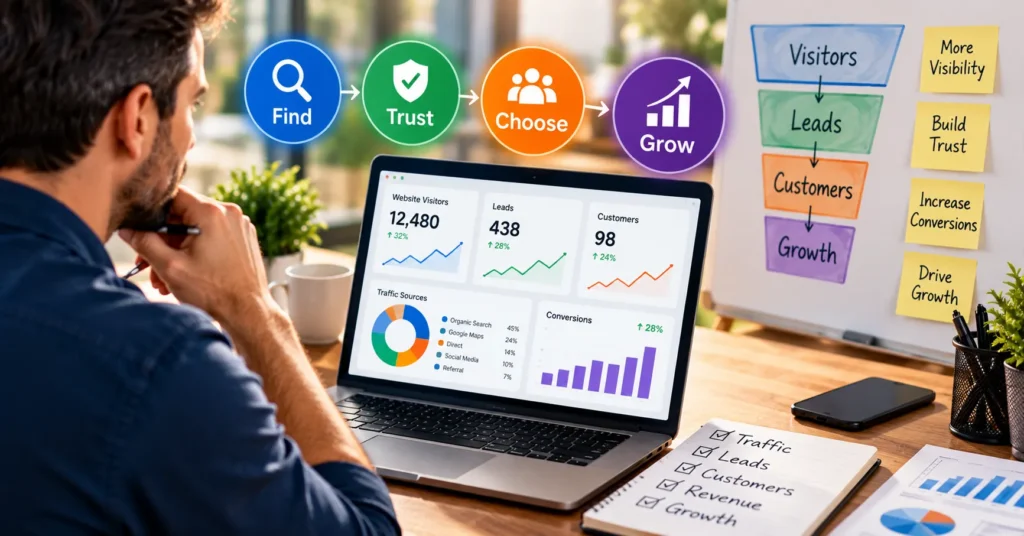
Your marketing is working when the right people can find your business, have reasons to trust it, and take the next step toward becoming customers. Lead tracking helps connect those actions to business results. For a small business owner, the goal is to understand whether your marketing is creating opportunities that support growth.
At Davenport Marketing, we organize that customer journey around Find. Trust. Choose. Grow. Our Business Growth Engine™ connects the strategy, execution, and ongoing improvements that support it. Looking at each stage helps you see what is working, where customers are getting stuck, and what deserves attention next.
How Do I Know If Customers Can Find My Business?
The Find stage is working when your business becomes more visible to people looking for the services you provide. Relevant Google rankings, Google Maps visibility, website visits, and discovery through helpful content can indicate progress. The question is whether that visibility reaches potential customers.
A contractor ranking for services in the towns it serves has a different opportunity from one attracting readers hundreds of miles away. Review which searches and pages bring people to your website, then connect that activity to inquiries. Davenport Marketing works on local SEO for small businesses, Google Business Profile optimization, keyword research, and search visibility to strengthen those connections.
Our blog, How Our Business Growth Process Works: Find. Trust. Choose. Grow., explains how discovery begins the journey. If relevant people cannot find you, visibility may be your first priority. If they already arrive, investigate what happens next before assuming you need more traffic.
How Do I Know If My Marketing Is Building Trust?
Trust is developing when prospective customers find credible reasons to believe your business can help them. Recent reviews, real project photos, clear service information, testimonials, and useful answers give people evidence to evaluate before contacting you.
Consider what a stranger sees when comparing your business with another provider. Can they understand your experience? Does your website answer their questions? Are your business details consistent? Davenport Marketing strengthens these signals through content marketing for small businesses, review strategies, and website improvements.
Trust cannot be reduced to one dashboard number. Watch for supporting evidence, such as customers mentioning reviews or helpful content during inquiries. Our blog, How to Get More Customers to Trust Your Business, explores how to build that confidence throughout your online presence.
How Do I Know If More Customers Are Choosing My Business?
The Choose stage is working when interested prospects take useful action, such as requesting an estimate, booking an appointment, or making a purchase. Track both the inquiries you receive and how many become customers. That distinction helps separate marketing opportunities from completed business.
Lead tracking should record the inquiry source, service requested, suitability, and outcome. Google’s guidance on key events explains how Analytics can measure important website actions and evaluate associated marketing channels. A form submission is a useful signal, but it still needs to be checked for quality.
Davenport Marketing’s small business digital marketing services include website improvements, calls to action, form optimization, and follow-up systems. Our blog, How to Get More Customers to Choose Your Business, explains how reducing friction can help turn interest into action.
Start with a manageable record of inquiries rather than trying to measure everything at once. Ask customers how they found you and record whether they booked. Over time, these details can reveal which services, locations, and channels consistently create the most useful opportunities.
At minimum, record the date received, service requested, location, stated source, qualification status, next step, current outcome, and—when available—revenue and estimated gross profit. A shared spreadsheet can work until lead volume or follow-up complexity makes a CRM worthwhile.
For source attribution, combine the customer’s answer to “How did you hear about us?” with analytics, form data, call tracking when appropriate, and consistent campaign tags. A prospect may discover you in search, read reviews, return later, and then call, so use attribution as decision evidence rather than pretending one source tells the whole story.
What Do Conversion Rates Tell Me About My Marketing?
Conversion rates show how often people move to a defined next step. For example, 1,000 website visits producing 20 inquiries equals a 2% visit-to-inquiry rate. If the same traffic produces 30 inquiries later, that rate rises to 3%, assuming tracking remains consistent.
If 20 qualified inquiries lead to 12 estimates and five customers, the lead-to-opportunity rate is 60%, and the opportunity-to-customer rate is about 42%. Tracking each stage shows whether the constraint is visibility, lead quality, or sales follow-through.
However, those extra inquiries need to fit your business. If qualified inquiries increase but sales remain flat, examine response times, availability, estimates, and follow-up. Find may be improving while Choose still needs work. This is why reviewing the whole customer journey is more useful than celebrating one isolated increase.
Also record why opportunities are lost—such as a service-area mismatch, the wrong service, price, slow response, limited capacity, or missed follow-up. That separates a marketing-quality problem from a sales or operations problem.
How Do I Know If Marketing Is Helping My Business Grow?
Grow means connecting marketing progress to the business goals you set. That could include more profitable customers, stronger demand for a priority service, repeat business, or growth in a new service area. Compare those outcomes with your investment and capacity to serve customers well.
The U.S. Small Business Administration’s marketing guidance recommends comparing marketing and sales costs with revenue generated. Also consider profit margins and repeat purchases; higher revenue alone does not establish a profitable return.
Revenue alone can hide a weak return. Compare marketing and sales costs with the gross profit from customers acquired, then consider repeat business and delivery capacity. A channel that produces fewer but more profitable, right-fit customers may be the stronger investment.
Davenport Marketing brings analytics, monthly reporting, and quarterly business reviews into the growth process. The purpose is to identify which activities deserve continued investment and which need adjustment. Lead tracking helps connect the early stages of Find and Trust with the customer outcomes that make Grow meaningful.
How Does the Business Growth Engine Improve Marketing Results?
The Business Growth Engine turns findings into a prioritized plan through five steps: Diagnose, Design, Build, Drive, and Compound. We diagnose what is holding the business back, design a roadmap, build the foundation, drive qualified opportunities, and continually improve the system.
For example, if a business receives relevant traffic but few inquiries, the priority may be clearer messaging and easier contact options. If its website already converts well but few local customers discover it, visibility may deserve attention. The plan follows the problem rather than automatically adding another marketing tactic.
This approach gives owners a clear way forward. Your website, content, reputation, search presence, and lead tracking work toward shared business goals. The Business Growth Engine Playbook explains how those connected improvements support growth.
How Often Should I Review My Marketing Results?
Review key results monthly and revisit priorities more deeply each quarter. Consider seasonality, your starting point, and how long customers typically take to decide. A single slow month does not automatically mean your strategy has failed, and early visibility gains do not guarantee sales.
Each review should clarify what is working, what is changing, what is missing, and what happens next. You should leave knowing which part of the customer journey needs attention and what improvement is planned.
Your Business Is Your Expertise. Growing It Is Ours. If you want a clearer picture of your marketing and a practical plan for improvement, contact Davenport Marketing or call 321-405-2585. We’ll help you connect Find, Trust, Choose, and Grow to your business goals.
Frequently Asked Questions
Does More Website Traffic Mean My Marketing Is Successful?
More traffic can indicate progress in Find, but success also depends on who visits and what they do next. Use lead tracking to connect relevant traffic with qualified inquiries and customers.
Why Am I Getting Leads but Not More Customers?
Review lead quality and what happens after contact. Slow responses, limited availability, unclear estimates, or inconsistent follow-up may prevent suitable prospects from becoming customers.
What Should My Marketing Report Explain?
Your report should connect visibility, trust signals, inquiries, and customers to your goals. It should explain progress, acknowledge measurement gaps, and identify the next improvements your business needs.